

Article Context:
Ask most quality professionals what validation looks like, and they will describe a stack of executed test scripts. It is the most visible part of GxP software validation, which is why it gets mistaken for the whole job.
But when an inspector reviews a computerized system, the scripts are rarely the first thing they ask about. They ask who owns the system, how changes are controlled, who has access, and how you know it still does what you validated it to do.
Teams that can answer those questions quickly walk into inspections with confidence. Teams that can’t learn the gaps the hard way, with the inspector watching. CG Learning Academy’s General Software Quality and Validation course gets your whole team ready to answer them in about 6 to 8 hours.
The Real Gap: Evidence Without Context
A test script proves a function worked on the day it was tested. It says nothing about whether the requirements were right, whether the risks were understood, or whether the system will be changed tomorrow without anyone checking. Teams that treat validation as a testing exercise tend to produce thick protocols and thin assurance.
If your team is producing thick protocols but can’t explain the reasoning behind them, the gap is understanding, not effort. That is the gap the Academy’s lifecycle lessons are built to close.
The Software Validation Lifecycle
The software validation lifecycle is the reason the scripts exist, and it tells you which ones are worth writing:
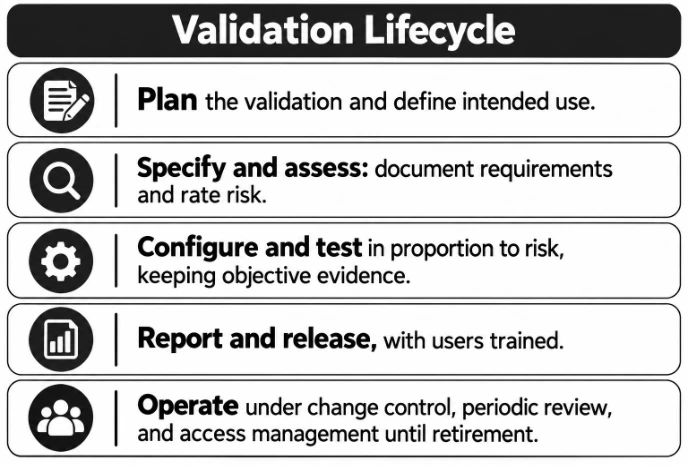
Notice how little of that sequence is test execution. Testing is one input among many, and its value depends entirely on the requirements, risk assessment, and controls around it. That is why a thin package built on strong lifecycle thinking often outperforms a thick one built on scripts alone.
The People Behind Validation
Validation succeeds or fails on clearly defined responsibilities.
- System owner is accountable for intended use and risk.
- Process owner confirms requirements reflect reality.
- QA approves deliverables and decides whether evidence supports release.
- IT manages infrastructure, security, and technical change.
- Testers and the supplier provide hands-on verification and leverageable evidence.
Problems appear in the handoffs: a requirement the process owner never reviewed, or a change IT made that QA never saw.
These hand-offs break when only one or two people understand the system’s risk. Enrolling QA, IT, system owners, and process owners in the same course gives everyone the same picture, with completion reporting to show it.
Processes, Controls, and Deliverables
A validated state is maintained by controls: risk management, change control, access management, audit trails supporting ALCOA+ and 21 CFR Part 11, supplier management, backup and recovery, periodic review, and training. Their depth should scale with the system’s risk.
Typical deliverables include a validation plan, user requirements, a risk assessment, specifications, test evidence with traceability, a deviation log, and a validation summary report. A risk-based approach lets teams combine or simplify these. The best is short, specific, and useful.
Consider a simple example. IT applies a vendor patch on a Friday. QA never sees the change record; the process owner is not informed, and nobody checks whether the validated functions still behave as intended. Each team did its job, yet the validated state quietly eroded. Clear roles, a risk-based impact assessment, and a shared understanding of why change control exists would have caught it in minutes.
Your team may already have a Friday patch story of its own. The question is whether the next one gets caught in minutes or found at the next audit.
Common Pitfalls to Avoid
- Treating go-live as the finish line: Most findings on computerized systems come from the operational phase, not the project phase.
- Validating the vendor system as if you built it: Assess the supplier and leverage what is credible instead of repeating it.
- Copying the last protocol: Intended use and risk differ between systems, so effort should, too.
- Leaving access unmanaged: Shared accounts, stale users, and unreviewed privileges undermine every record the system produces.
- Skipping periodic review: Without it, drift in configuration, procedures, and training goes unnoticed until an audit.
Each of these is a process failure rather than a testing failure, which is why more test scripts rarely fix them. They are fixed by ownership, procedures, and people who understand what the controls are for.
A useful check is to ask five questions of any validated system:
- Who owns it?
- What is it used for?
- How was its risk assessed?
- What has changed since its release?
- When was it last reviewed?
If the team cannot answer all five quickly, the validation package may be complete on paper while control has quietly slipped.
If your team couldn’t answer all five in under a minute, that is your signal. Preview 3 lessons from CG Learning Academy for free and see how quickly the gaps become clear.
Why Training Closes the Gap?
QA focuses on evidence and procedures; IT focuses on configuration and uptime. Without a shared vocabulary, even a conversation about change impact can stall. A practical computer system validation course gives both sides a common language of intended use and risk, which shortens reviews and reduces rework.
The cost of waiting isn’t one big failure. It’s another change made without QA’s knowledge, another review that gets skipped, another finding that was avoidable. Training is far cheaper than remediation.
For the wider context, read our pillar guide, The Validation Foundation
Don’t Wait for an Audit to Find the Gaps. Close Them This Month.
The General Software Quality and Validation course in CG Learning Academy covers exactly this ground: lifecycle expectations, roles, deliverables, and risk-based thinking, in 17 self-paced microlessons (about 6 to 8 hours). Practitioners who co-founded FICSA and co-authored ISPE GAMP 5 Second Edition wrote it, and every lesson ends in something you can apply that week.
Explore CG Learning Academy to see the catalog and team options, or preview 3 lessons before you decide.